

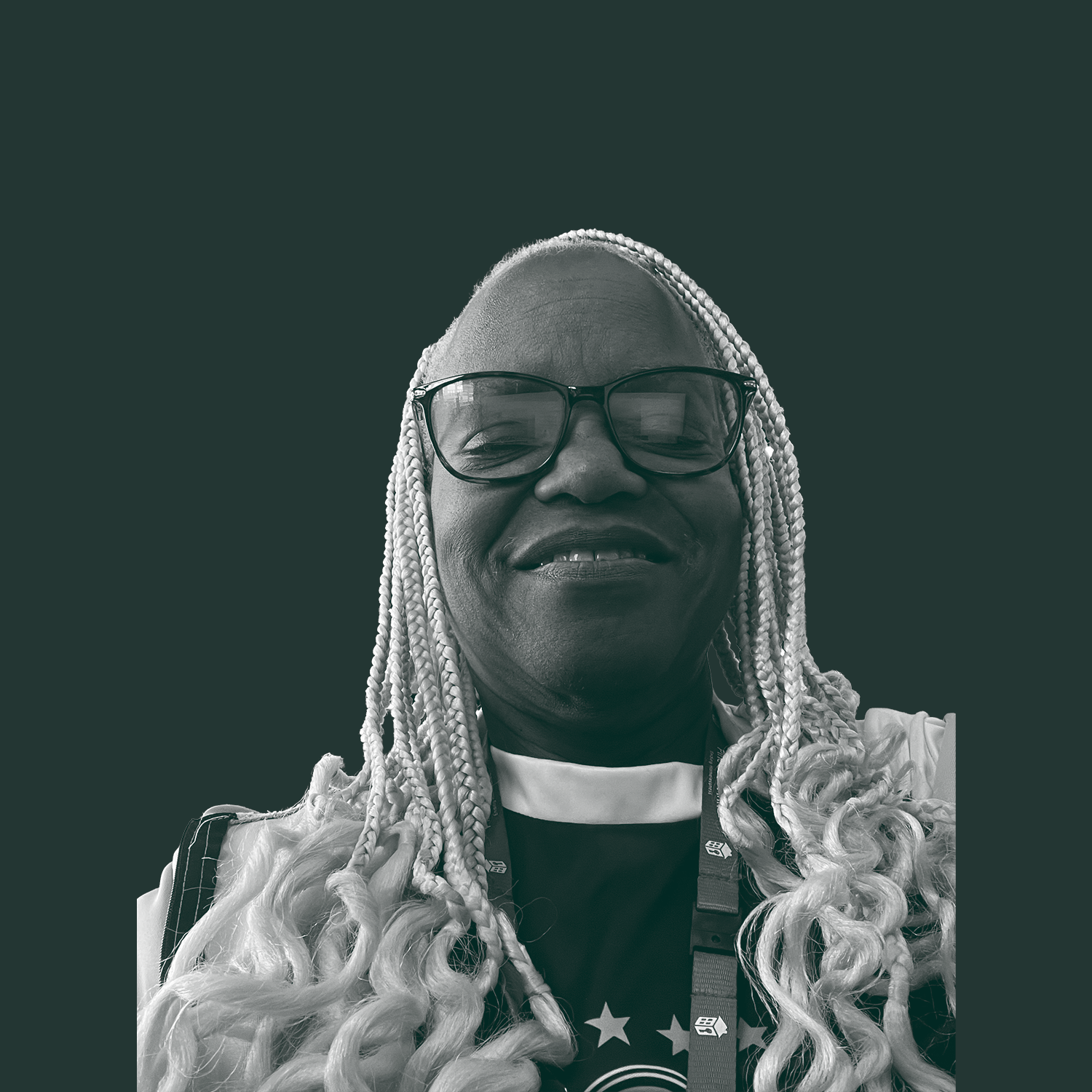
Meet Delphia Bizzell
Meet Delphia Bizzell, a Consumer Engagement Coordinator with lived experience at Pine Street Inn.
Funded by the Liberty Mutual Foundation, a 2026 partnership between Vital CxNs, Boston Public Libraries, and Pine Street Inn aims to turn libraries around the city into hubs of support for people experiencing housing insecurity.
We sat down with Delphia Bizzell, the Consumer Engagement Coordinator at Pine Street Inn, to hear her own journey overcoming homelessness, dismantle misconceptions about people who are unhoused, and learn about how she leverages her lived experience to drive change in the housing landscape.
Born in Louisville, Kentucky in 1963 into a middle-class military family, Delphia never imagined she’d one day be sleeping in supermarket lobbies and navigating Boston winters without a home. As an “army brat”, Delphia moved every two years, spending a large part of her childhood in Germany. Her veteran father ran the family household with strict discipline. A product of this discipline, Delphia earned not one but three degrees: one in marketing and advertising management, another in information technology, and finally, a Master of Arts in Business Communications, achieving one of her biggest goals in life. On paper, Delphia was destined for stability: education, a strong family foundation, a deep work ethic. But homelessness does not always follow the stereotypes people expect.
“I had the same stereotypes and stigma [towards people experiencing homelessness] until I became homeless.”
When her father died in 2001, Delphia and her husband, Terry, moved in with her mother whose health was failing so Delphia could care for her full-time. After her mother passed away, painful bureaucratic surprises began to surface. The Kentucky house her father believed would be paid off was still under mortgage, and Delphia was never added to the deed. The bank foreclosed.
Delphia and Terry suddenly had nowhere to go. Family members didn’t have room to take them in. They bounced between couches and shelters until Terry, who had lived in Boston before, called his sister there. She sent them bus tickets, and they arrived in November, expecting safety and shelter. Instead, nine days after they arrived, Terry’s sister put them out—into 24 inches of snow and subzero temperatures. Delphia had severe arthritis and was relying on a walker. Terry had a replaced hip. They tried sleeping inside a grocery store and then a hotel lobby, doing their best to blend in as guests until security made them leave.
They then moved into Boston’s shelter system—separate shelters. Delphia was shocked to learn, “There are no shelters in Boston where husbands and wives can stay together. If you don't have a kid, they don't consider you a family.” This was a challenging reality for them because in 28 years they’d never been separated before.
They spent two and a half years in shelters, surrounded by hundreds of other people every night. She describes it as a complete loss of autonomy and dignity. “You lose everything when you become homeless. Your dignity goes out the door,” Delphia says. “[In homeless shelters] you’re treated like a child, told when to get up, when to go to bed, when to eat, when not to eat.” But even in the middle of that experience, she and Terry held tightly to each other. “We leaned on each other,” she says. “Without support, you cannot [get through homelessness] by yourself.”
“I want to show people you can get out of homelessness, it just takes a whole lot of work.”
Driven by this belief, Delphia began her journey in advocacy. She joined the Boston Advisory Council on Ending Homelessness (BACHome Council), a group of people with lived experience who meet regularly to advise city leadership on issues related to housing insecurity. Delphia eventually became a board member of Winter Walk in Boston, an event focused on raising awareness about homelessness, and joined the board of the Massachusetts Housing and Shelter Alliance (MHSA). She has spoken at Harvard, Tufts, national conferences in Washington, D.C., and in San Jose, sharing not only her own story but also the broader truth of who becomes homeless.
Delphia refers to herself as an example of how homelessness doesn’t always look like the person you see on the street struggling with substance use or mental health issues. In fact, in the shelter she met former professors, doctors, ballet dancers, and lawyers. Reflecting on how pervasive society’s limiting narrative of homelessness is, Delphia admits, “I had the same stereotypes and stigma [towards people experiencing homelessness] until I became homeless.”
Eventually, through persistence and with the help of local organizations, Delphia and Terry secured housing with a voucher. For the first time in years, they had a stable place to call home. Her journey made Delphia realize, “A home is not just a place for living. If you don't have a home, you can't keep yourself clean. If you can't keep yourself clean, you can't get a job, if you can't get a job, you can't afford health care. It’s a vicious cycle that you stay stuck in.”
“I tell everybody, ‘It takes a village to raise a child, but it takes a village to end homelessness as well.’”
Today, as a Consumer Engagement Coordinator with lived experience at Pine Street, she has created consumer and resident advisory boards, helping people in shelters and supportive housing find and use their voices. Through all her roles, she teaches storytelling, connects people to opportunities like national conferences, and advocates for policy changes that center those who’ve lived through homelessness. “I want to show people you can get out of homelessness, it just takes a whole lot of work.”
Her message is clear: people experiencing homelessness are not looking for charity—they’re looking for a chance.
Delphia says. “Once you’ve been homeless, you never forget it. So that’s become my passion now.” That passion led MHSA to honor her in June 2026 with the Rep. Byron Rushing Commitment to Housing Award for her efforts advocating for people experiencing homelessness and changing the stigma they face, as well as trying to improve the fragmented and under-resourced system of homeless services. “I tell everybody, ‘It takes a village to raise a child, but it takes a village to end homelessness as well.’”
Written by Briana Acosta (June 2026)